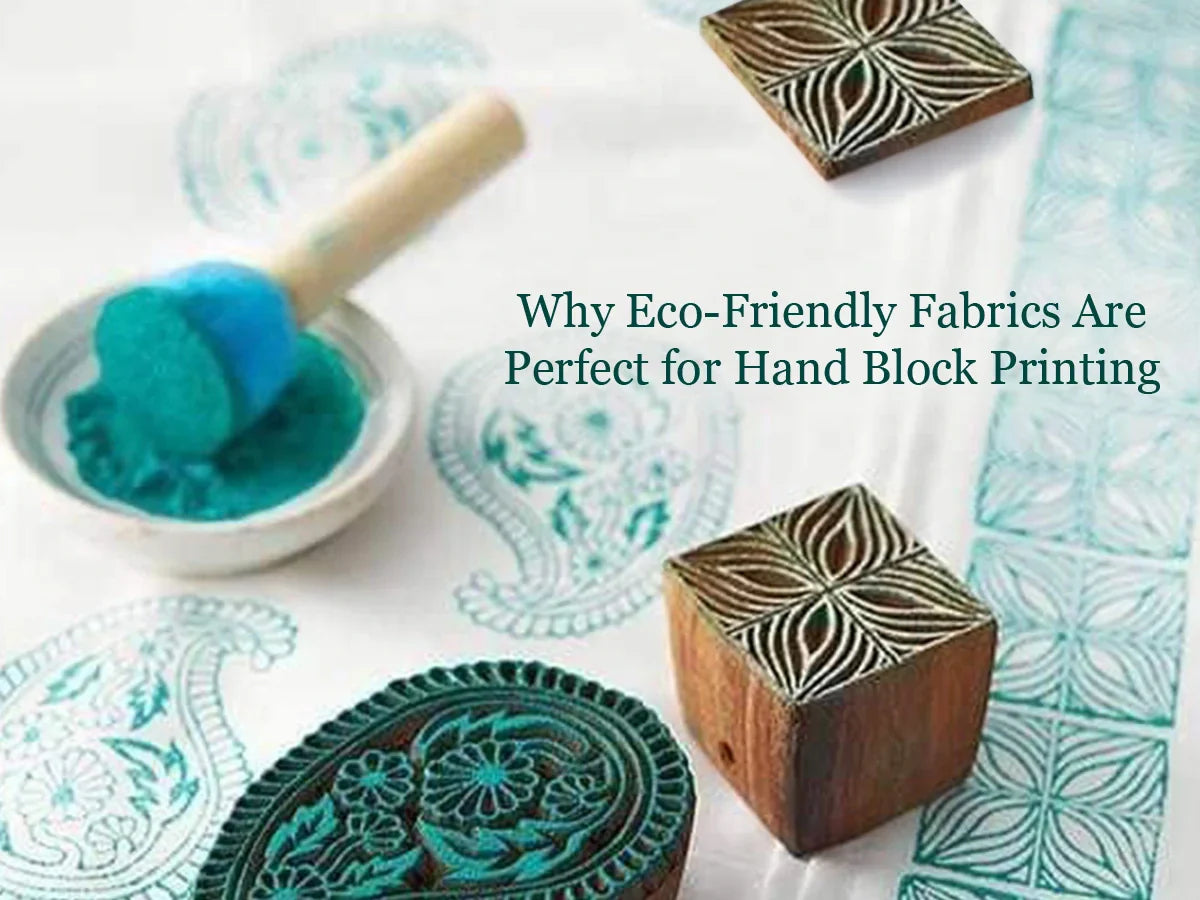
Why Eco-Friendly Fabrics Are Perfect for Hand Block Printing
Most people choose a fabric for how it looks. Artisans who practise hand block printing choose it for how it responds. Press a carved block onto the wrong fabric, and the print bleeds, fades, or simply refuses to hold. Press it onto the right one, and the colour sinks in cleanly, the edges stay sharp, and the piece lasts for years. The right fabric, almost always, is an eco-friendly one.

The relationship between eco-friendly fabrics and block printing is not a marketing angle. It is a practical reality rooted in how natural fibres behave under dye and pressure. Understanding this makes it easier to appreciate why the two belong together.
How Natural Fibres Respond to the Block
Natural and sustainably sourced fibres have an open, porous structure. When a block loaded with natural dye or pigment is pressed firmly onto organic cotton or linen, the colour is drawn into the weave rather than sitting on the surface. The result is a print with clean edges, consistent depth, and a richness that improves with wear rather than diminishing.
An artisan working with organic cotton, for example, can feel the resistance of the fabric as they apply pressure to the block. That resistance is the fibre accepting the dye. The texture of the cloth becomes part of the print, giving each piece a quality that no machine-printed fabric can replicate. This is what makes eco-friendly fabrics ideal for hand block printing: they are active participants in the process, not passive surfaces.
Natural dye on natural fibre creates a bond that holds. The colour does not sit on the cloth; it becomes part of it.
Why Synthetic Fabrics Don’t Work Well for Block Printing
Polyester and other synthetic fabrics are engineered for uniformity, which sounds like a virtue but works against hand block printing in every practical sense.
|
SYNTHETIC FABRIC |
ECO-FRIENDLY NATURAL FABRIC |
|
Repels water-based natural dyes |
Absorbs dye deeply into the fibre |
|
Colour sits on the surface, fades quickly |
Colour bonds at a molecular level |
|
Edges bleed or appear uneven |
Clean, sharp print edges every time |
|
No texture for dye to grip |
Texture adds character to the print |
|
Requires chemical fixatives |
Compatible with plant-based natural dyes |
Beyond the print quality, synthetic production involves petrochemicals, high water consumption, and fibres that do not biodegrade. Pairing that kind of material with slow, handcrafted work is a contradiction in both practice and values.
The Best Eco-Friendly Fabrics for Block Printing
Not all natural fabrics behave the same way under a block. Each has its own character, and choosing the right one depends on the design, the dye, and the final garment.
Organic Cotton
The most widely used fabric for block printing. Its soft, open weave absorbs pigment evenly, making it reliable for both fine geometric patterns and bold florals. A white organic cotton kurta printed with indigo holds its colour wash after wash.
Linen
Linen’s natural texture gives printed patterns a slightly irregular, artisanal quality that feels intentional rather than imperfect. It is especially suited to earthy, botanical block designs where the grain of the fabric adds to the overall look.
Tencel (Lyocell)
Produced in a closed-loop process with minimal waste, Tencel has a smooth, silky surface that captures fine detail with precision. It is the preferred choice when a design has intricate linework that needs to stay crisp.
Khadi
Hand-spun and hand-woven, Khadi carries its own heritage that aligns naturally with block printing. Its uneven surface means no two printed pieces are identical. A Khadi dupatta block-printed in madder red is, by definition, one of a kind.
Craftsmanship That Respects the Whole Chain
Hand block printing takes time. A single saree can take a skilled artisan several days to complete, working section by section, cleaning and reloading the block with each impression. It is not a process designed for shortcuts, and the fabrics used should reflect that.
Eco-friendly fabrics are grown and produced with lower water usage, fewer synthetic inputs, and fairer conditions for those who work with them. When a customer wears a hand block printed piece on organic linen, they are carrying the effort of the farmer, the weaver, the dye-maker, and the artisan. That is a chain worth respecting from start to finish.
Comfort That Lasts Beyond the First Wear
Natural fabrics breathe. They regulate temperature, soften with washing, and sit well against the skin through a long day. A block-printed dupatta in organic cotton drapes beautifully and gets better with age. The same design on polyester would feel different within a season.
Dresses made with eco-friendly fabrics for block printing do not go out of season because they were never chasing a trend. They are made carefully, from the right materials, to be worn for years. That kind of longevity is the most honest form of sustainability.
——◆——
Every dress in the Golden Lotus Global collection is made this way: natural fabric, traditional block, unhurried craft.